
Our policy
The Simultaneous Policy is a series of multi-issue policy packages to solve global problems. Each package will be implemented at the same time, on precisely the same date, by all or sufficient nations. But what issues would those policy packages include, how are they being put together, and by whom?
What makes a Simultaneous Policy?
There are five criteria that define a Simultaneous Policy:
1. Simultaneous Implementation
To avoid any nation suffering a competitive disadvantage, each Simultaneous Policy package must be implemented by all or sufficient nations at the same time, on the same date.
2. Subsidiarity and Protecting National Sovereignty
Not every issue needs to be covered by a Simultaneous Policy. At Simpol, we are only concerned with global issues that need all or sufficient nations to act together. If an issue can be resolved by a nation alone, without any significant negative consequences for its international competitiveness, it doesn't qualify for being included.
For example – what a nation may decide regarding the death penalty or abortion will not have any significant impact on its attractiveness to international businesses or investors, therefore it isn’t something that requires international cooperation to solve. While we, at Simpol, are passionate about many issues, it is only those that require global and simultaneous implementation that qualify for consideration.
3. Multi-issue framework
Each Simultaneous Policy package will bring together two or more issues that meet the above criteria. Instead of treating an issue like carbon emission reductions in isolation, we will combine it with another issue – such as a global currency transactions tax
Simpol combines multiple issues because addressing any single issue in isolation inevitably means some nations winning and others losing. When you look at the 2015 Paris Climate Agreement, you can see that the big carbon emitters like the U.S. and China have much more to do, and lose, by entering into the agreement. This only undermines their commitment or causes them to abandon the agreement altogether, as the United States has now done twice.
That’s why Simpol combines two or more issues into one policy package, so that what a nation might lose on one issue, it can gain on another. That way, immediate action becomes in all nations' interests.
4. Detailed policies, not targets
Instead of mere targets for nations to achieve, Simpol's policies would consist of the detailed measures each nation commits to implementing. That way, trust and transparency are assured. Every nation knows what every other nation will do and when.
5. Verification and enforcement
The essence of Simpol is to construct global agreements that are not only in the global common interest, but also in every nation's self-interest. In that way, it will also be in all nations' interests to include measures for the agreement's verification and enforcement.
For more on Policy Development at Simpol, download our Information Pack.
Policy Content
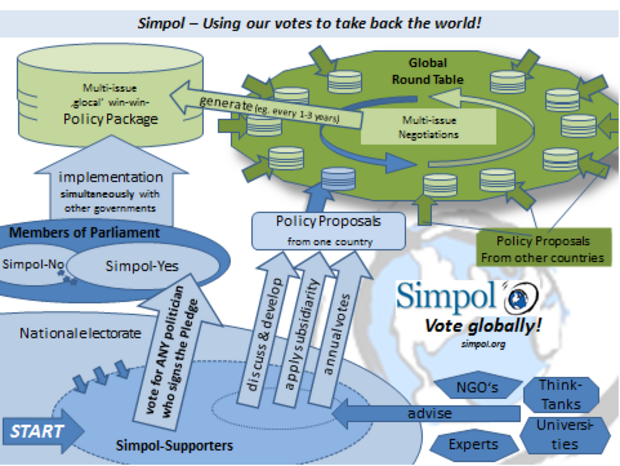
The content of each Simultaneous Policy package will be developed by experts and NGOs and agreed by the governments of all participating countries. Citizens help decide which issues come first, and their agreement will be sought before any package is implemented. To understand how this would work, please see our Information Pack.
Once a Simultaneous Policy package has been developed and agreed by all or sufficient nations, they implement it simultaneously on a mutually agreed date. Subsequent packages follow the same process. The process only begins when more or less all democratic countries, together with the major non-democracies, have signed the Simpol Pledge. Until then, we continue to campaign to get politicians, political parties and governments to sign it.
We are also working with experts and academics to model potential Simultaneous Policy packages in advance using the Smartsettle Infinity multi-issue negotiation platform.